Hands On Astronomy

For Homeschool

Learn together as a family, then go outside and know what you're looking at tonight

"Science should be about problem solving, not just copying steps"

It's as Easy as 1, 2, 3

Learn the basics of astronomy, then go outside and know what you're looking at tonight.
1

Buy a Kit

Order an "AstroWhiz" kit for your family and we'll ship it right to your door - EVERYTHING you need included!
2

Solve Challenges

Open the box and start right away with Chapter 1, Level 1. 

Learn through challenges and questions that start simple, then slowly increase in difficulty as your kids (and you!) figure it out.
3

Learn Science

Along with each challenge there's a brief science explanation on the "Science Moment" card.

Understanding the science is essential to figuring out future challenges, so kids actually learn science along the way!

No Items to Gather

(All the physical components you need are in the box)

No Reading Ahead

(Just open the box and start the first challenge)

No Science Background Needed

(Challenges, components, and explanations are all in the box)

It's Never Been So Easy...

With an AstroWhiz kit YOU CAN:
  • Have confidence your child is ACTUALLY LEARNING
    (When your child can identify multiple constellations, point out the moon and tell you if it's waxing or waning, and know why there's a meteor shower coming up, you know they're actually learning)
  • Watch your children CELEBRATE their success
    (Kids feel so much pride as they SOLVE real challenges, figure out tough problems, and move on to the next level)
  • Spend More Time Living Life
    (Just open the box and go - spending only one hour a week on a real science curriculum that your kids love means you can spend less time doing school and more time living life)

AstroWhiz Options

Easily Teach Electricity

Hands On

(The physical components are the main idea, not an extra. And everything you need is in the box)

Open and Go

(Your kids can even start without you! Just open the box and start the first challenge)

10 Minute Lessons

(Challenges take 5-15 minutes - do one a day or several in one sitting. You choose how to do science with your family! )

Finally! 
A Focus on Problem Solving, not Instructions

Most science kits focus on the end result - do "this", then "look you did it!"

But do your kids actually understand the science behind what just happened? 

Could they recreate it on their own?

Probably not...

But at least they did what they were told!

Real science learning, isn't simply about knowing the "right answer"

The best scientists and engineers aren't the ones that simply regurgitate answers - they're the ones that use their knowledge to solve real life problems.

Instead of telling kids what to do, our kits provide various challenges - each level has a question to answer or something to create. 

This allows your children to problem solve, experiment, try again, and figure out a solution.

They become the problem-solvers our world so desperately needs.

What Makes our AstroWhiz Kits Unique?

Focus on Problem Solving, NOT Solely Imparting Information

Most science kits focus on just the information - "look at how cool this is!" 

But most kids listen without truly understanding what's going on or knowing why it matters to them.

We give kids hands-on challenges - starting simple and slowly increasing difficulty - so they feel the momentum and see the success.

As they figure it out, they internalize and intrinsically understand the science behind it.

Hands-On Astronomy

How did we make astronomy hands-on?  Good question.

We use physical components as models.  We ask kids questions and give them challenges rather than just having them listen all the time. 

We invite kids to use real astronomy tools - compasses, star charts, red lights, and more.

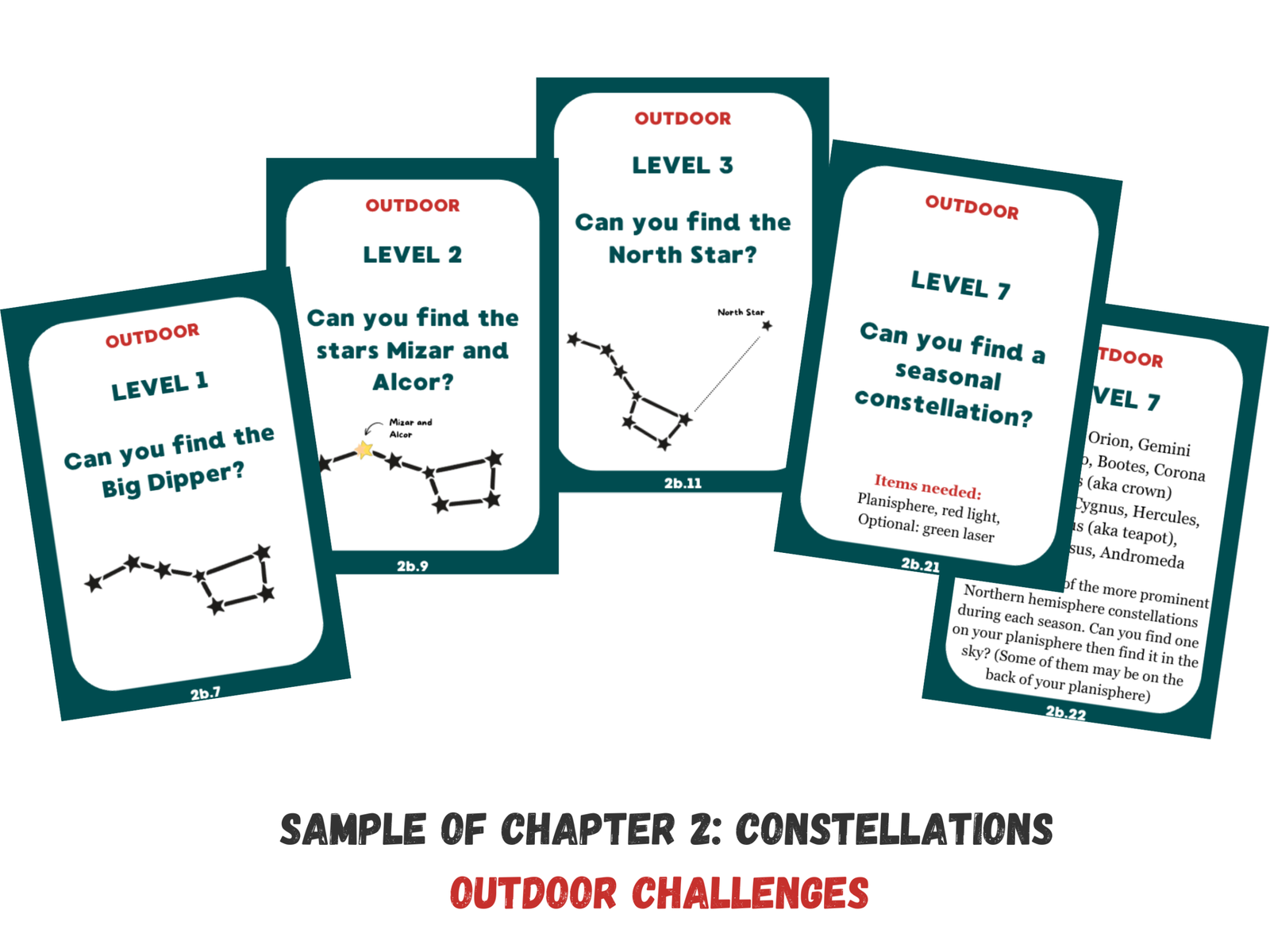
We created indoor AND outdoor challenges so you can keep learning inside and enjoy being in the night sky finding various constellations and objects you already learned indoors.

See the Progress

Kids love the thrill of leveling up in games. 

They love seeing their progress and how much they've accomplished.

AstroWhiz science kits feel like a game as your child moves from level to level, figuring out harder and harder challenges.

Your kids know they're learning... and that's fun for everyone.

Spend More Time Living Life

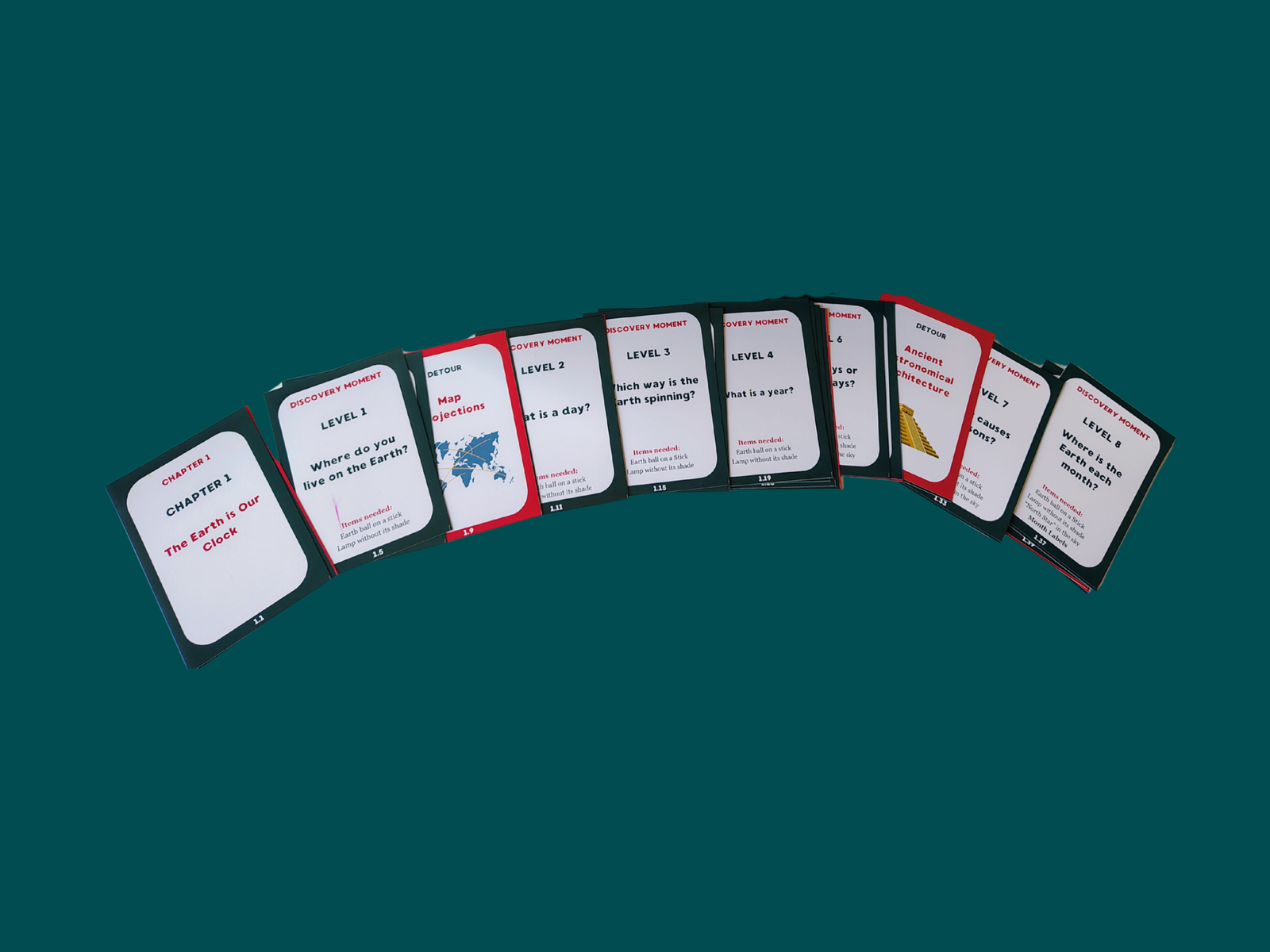
No prep work. No gathering things. Just open the Chapter 1 box and go through the challenges written on the cards.

In just one hour a week, your family can dive deep into how the movement of the Sun and Earth affect every aspect of our lives, identify real constellations, know about planets and more!

PLUS! Included are "Detour" cards with topics you can choose to learn more about by watching YouTube videos, reading books, or simply talking about new ideas that are interesting to YOUR family.

Know that your kids are getting a great education without taking an unreasonable amount of time.

Engage the Whole Family with ONE Curriculum

Learning science is more fun as a family, but we can expect more out of our older kids than our younger ones!  

Go through the challenges as a family, then invite your older children to think more deeply with the "Dig Deeper" questions on the challenge cards.  (That was my 5th and 7th graders favorite part!)

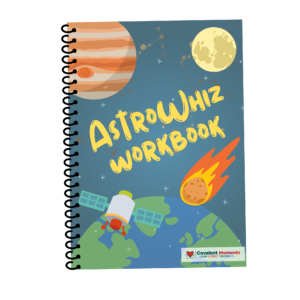
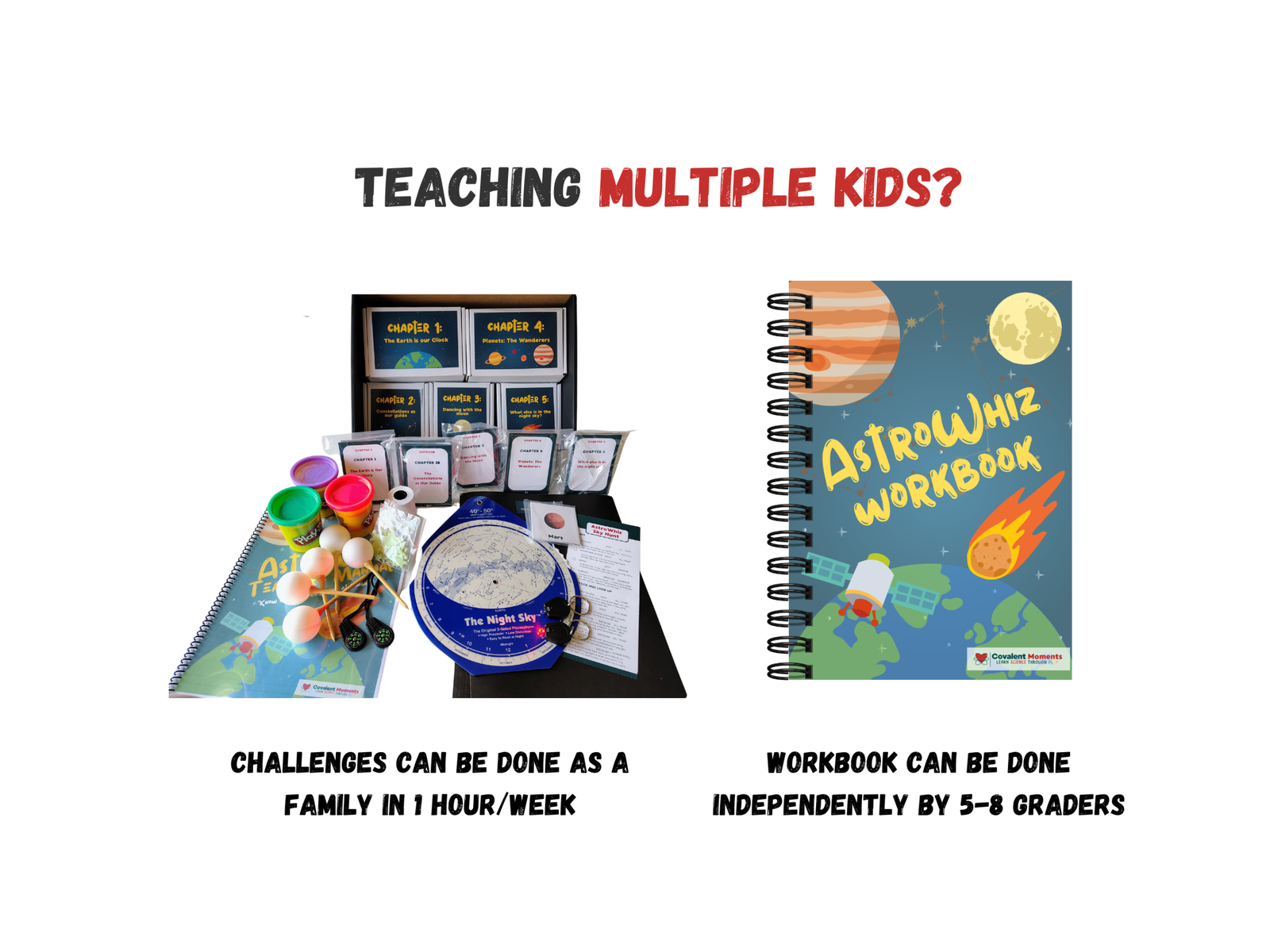
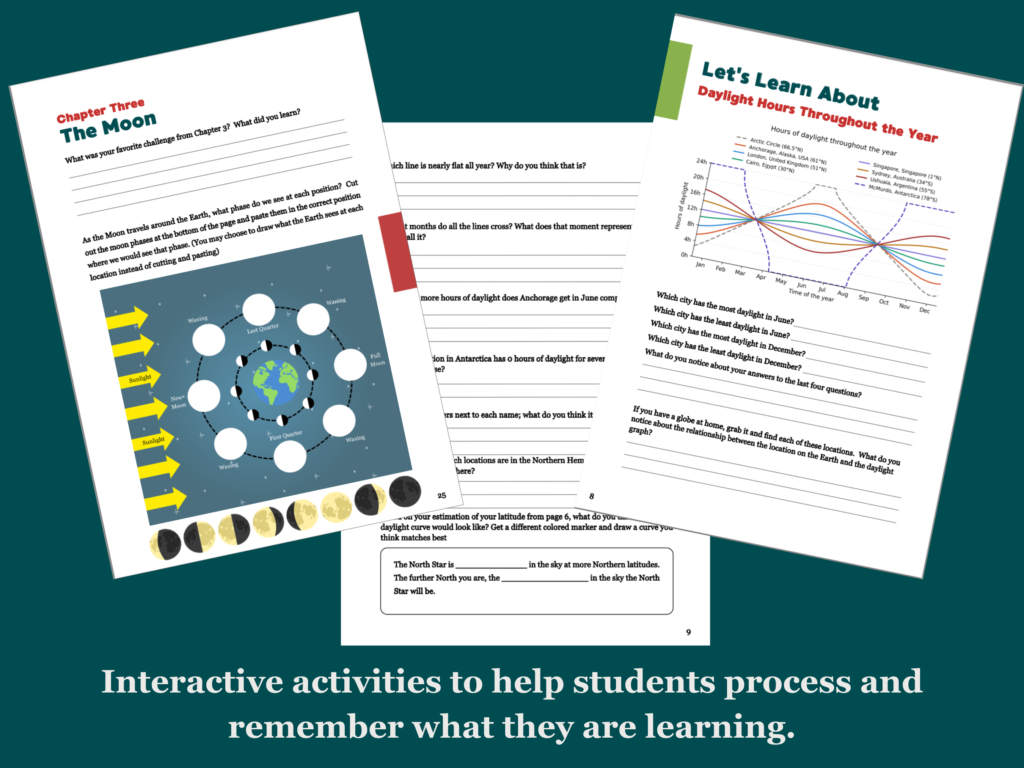
PLUS! The optional workbook is designed for independent study by those in grades 5-8 to record the things they're learning and explore even more topics in fun, engaging, and puzzling ways.  

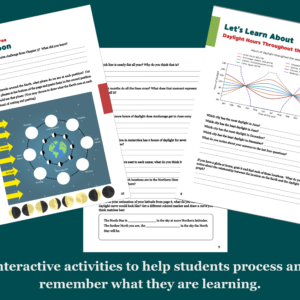
Interactive Workbook for Middle Schoolers

The workbook introduces more ideas and allows kids to record what they're learning.

This is narrating, problem solving, graph reading, logic puzzling, and learning all in one book. 

This isn't just busy work.  These are fun ways to learn more about astronomy topics that are more advanced for younger elementary students. 

Also includes a short quiz for each chapter.

Frequently Asked Questions

This is ideal for ages 8-14, though we've had plenty of adults and older teenagers that have learned a lot and been stumped by some of the challenges.  We have had plenty of younger kids join in on the discussions with older kids and parents, but we recommend waiting a year or two if your oldest isn't yet in 3rd grade.

There are 5 Chapters (each with 8-10 levels) that cover different topics:

  • How the movement of the Earth affects our days, seasons, sunlight, and more
  • Constellations
  • Phases of the Moon
  • Planets in our Solar System
  • What other things are in the night sky?

Yes!  That's what makes astronomy so fun.  Everything in this kit is designed to encourage your family to spend some time outside looking at the night sky together.

BUT... I know that you can't always go outside when you want to.  It's a cloudy or rainy night.  Kids need to go to bed early.  etc.

This curriculum has indoor challenges and outdoor challenges.  Most of the learning happens in the indoor challenges, but when you get a chance to go outside you can take the outdoor challenges and work on them when you get a chance. 

This way you can enjoy the night sky, but on your own timescale and you don't need to limit your indoor learning until you make it outside.

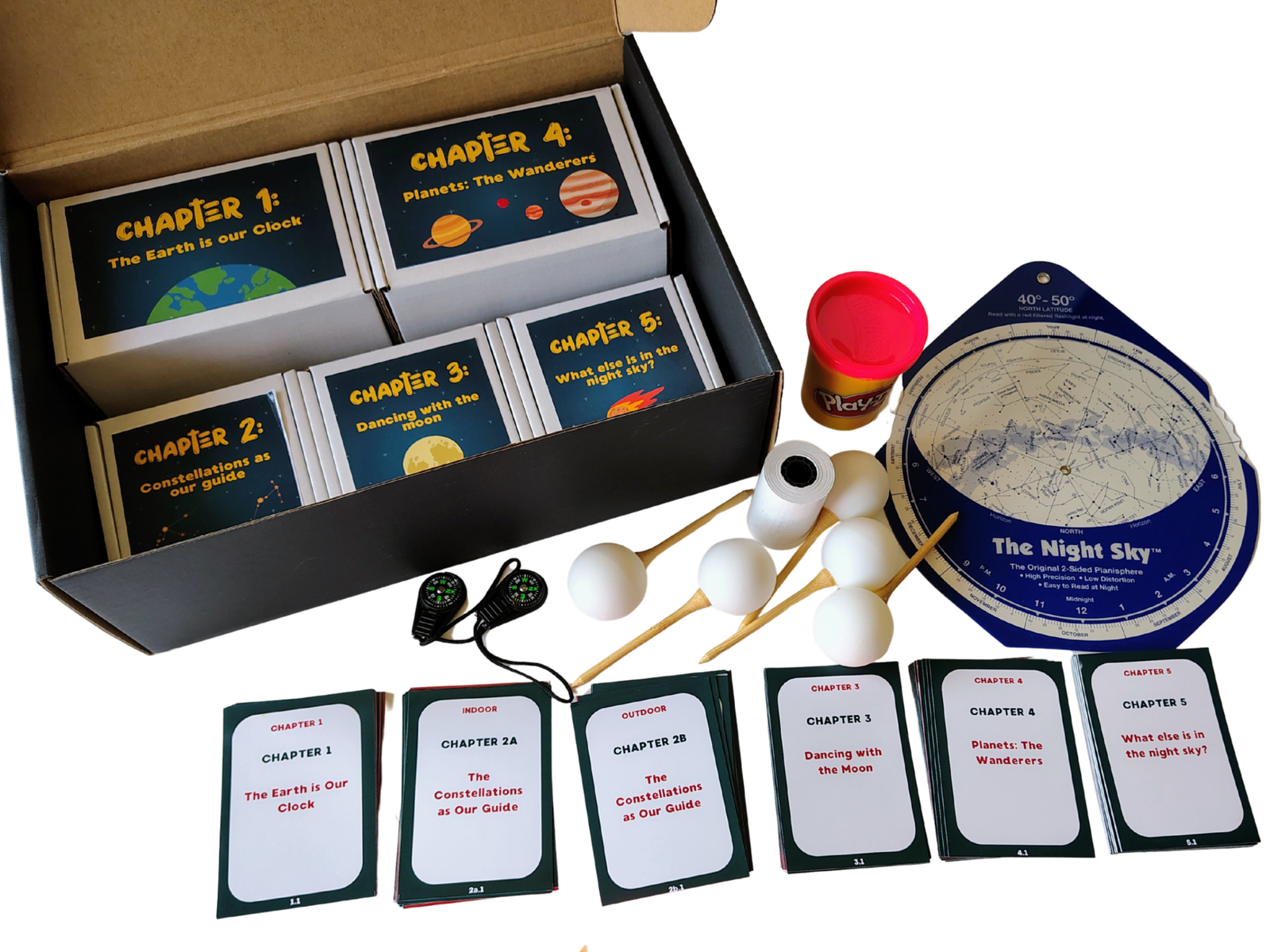
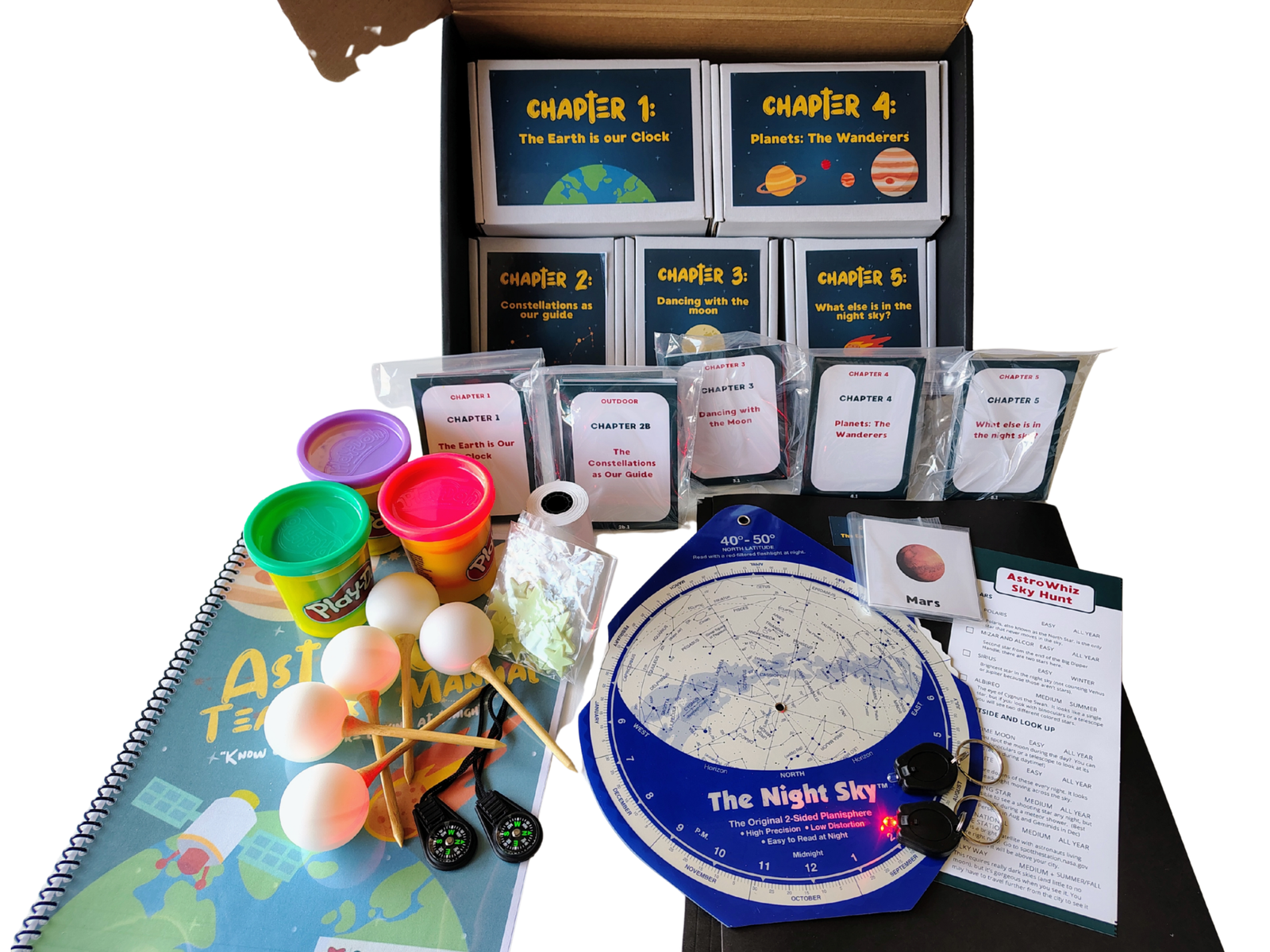
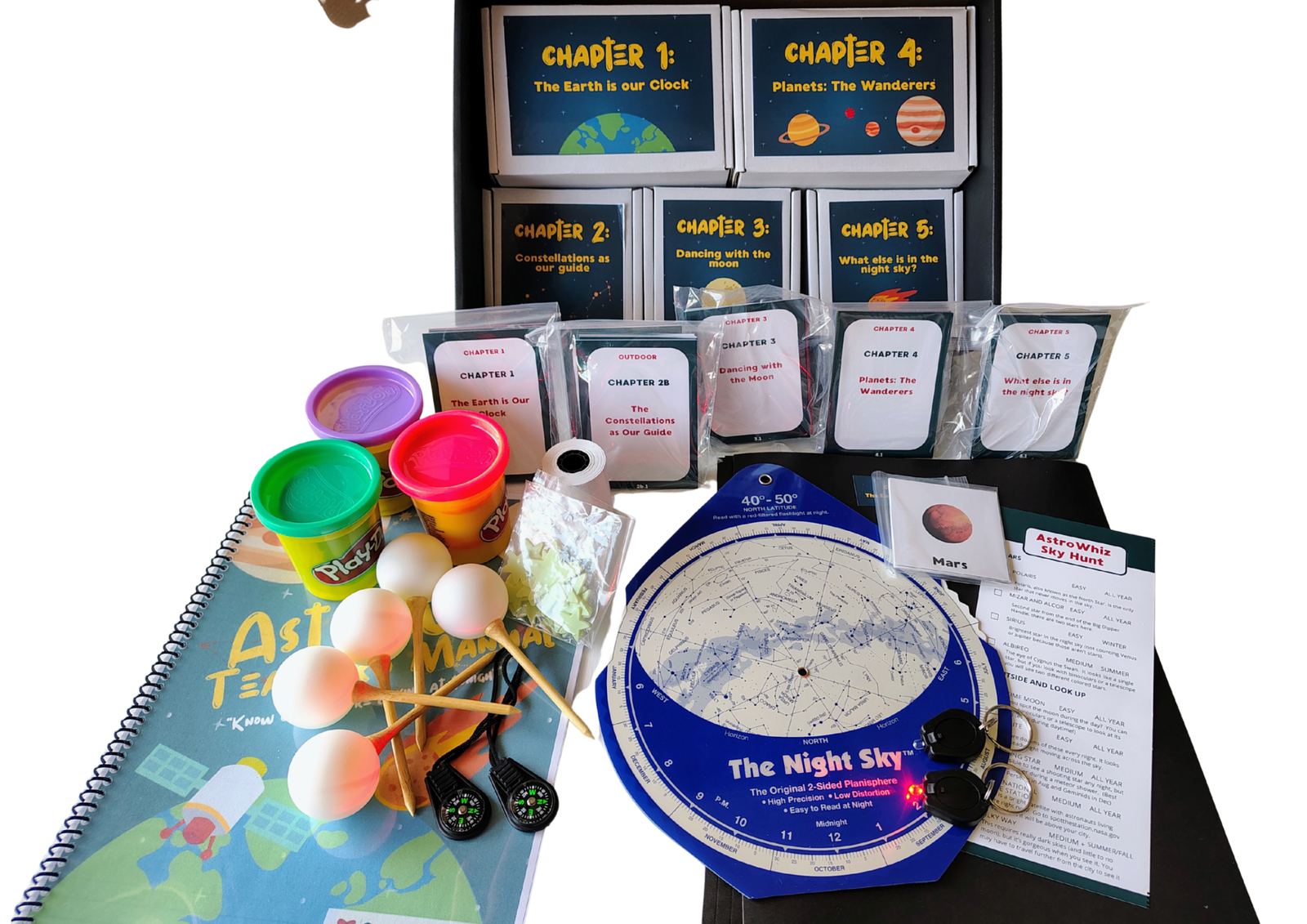
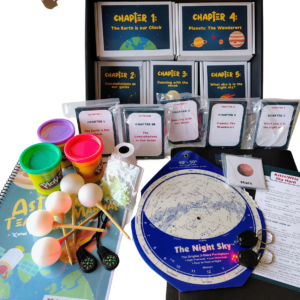
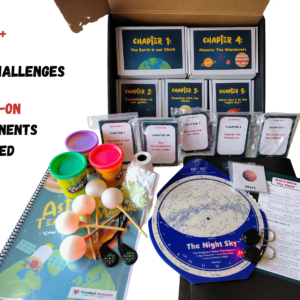
This was kind of tricky - but we know that hands-on learning is best for kids and adults alike!  We include the following components to create as much hands-on learning and modeling as possible:

  • Balls on a stick (so they can model the Earth's movement around the Sun and the Moon's movement around the Earth)
  • Glow-in the Dark Stars
  • Constellation Print outs
  • Professional Star Chart for outdoor stargazing
  • Little Red Light (used in astronomy to preserve night vision when outdoors at night)
  • Play-Doh (for modeling planet sizes)
  • Receipt Tape (for modeling planet distances)
  • Planet Manipulatives
  • Deep Sky Object Manipulatives
  • Night Sky Gazing Checklist 
  • And more!


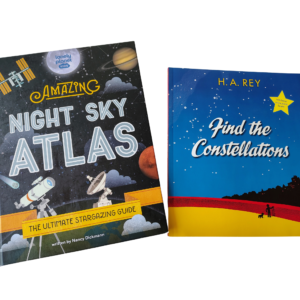
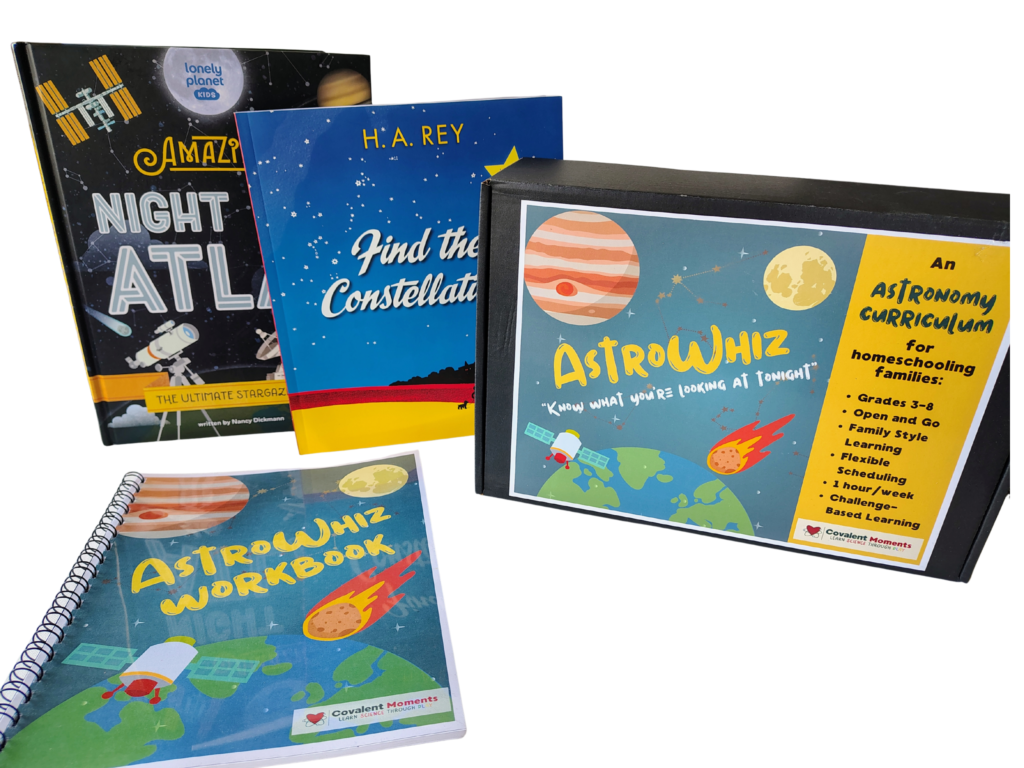
  • Optional: Living Books  (These are necessary to go through the course - you can get them from us, your library, or buy them elsewhere)
  • Optional Green Laser (These are optional, but highly encouraged for outdoor learning!  (It's hard to see which stars people are pointing at, but the laser makes it clear and obvious and easy for a group to look at the same location in teh sky.  These can be dangerous for kids so we don't include these automatically unless the parents request it).

Hi!  We're the Jensens.  We are a homeschooling family of six that loves science, games, and learning.  Linsey (Mom) has a bachelor's in physics and a master's degree in education.  Scott (Dad) has a PhD in physics.  And all four children are great play testers of all our experiments. 

We are proud of this curriculum because of the way it uses our physics knowledge, education and parenting experience, as well the fun and excitement we've experienced in thousands of hours playing and creating games to create something truly captivating and memorable.  

These kits are hand put together in our home in Heyburn, Idaho by everyone in the family. This is truly a small, family-run business.

Yes!  Built into this curriculum, in between challenges, are "detours" with questions and ideas that you can explore on your own if you want to.  And you can always complete any of your own "detours" with anything that comes to mind. 

Some examples include: 

  • Ancient Astronomical Architecture - How Chichen Itza, Stonehenge, and others were built around the movement of the sun and people still gather at these locations on the equinoxes and solstices to see these ancient marvels
  • How Native Americans used the phases of the moon to monitor time
  • Holidays based on the Lunar calendar
  • Difference between Astronomy and Astrology
  • What happened to Pluto?
  • Where do meteor showers come from?

And so much more!

Did you learn to ride a bike by reading instructions? As humans, we all learn better through experience, through trial and error, and through problem solving.  Not from reading a textbook.  Each of the challenges guides kids to discover solutions through problem-solving and modeling allowing them to learn by experimenting and exploring. 

The challenges are specially curated to slowly but surely build on each other so that it pushes kids to the edge of their understanding -- everything is within their grasp.  It’s designed to be engaging while building confidence and real understanding because they are solving real problems! 

This is tough to answer - each kid and each family is different.  

On the Short End - you could go through this in six weeks.  One chapter a week, but spending 2 weeks on constellations since that chapter has both an outdoor and and indoor component.

On the Longer End - you could easily take 12 or more weeks, or even a full semester, to study the topics in this astronomy curriculum.  If you complete every challenge, go down every "detour" and complete each workbook page, there's enough content here to fill a lot of time. 

If it were me - I'd take 8-10 weeks and give us a chance to do some extra learning and take our time savoring the various ideas and challenges.

We suggest completing each challenge, but the detours and workbook pages are all optional and allow you to go deeper into various topics and ideas.  Some of the best moments in homeschool is when you can binge YouTube videos learning about something you didn't even know you wanted to know! This curriculum is built to give you the flexibility to do that without making you feel like you're "falling behind".

Great!  This is meant for beginners and veterans alike.  We start at the beginning - learning about the Earth's motion around the sun, and how that impacts what we see each day and night.  As we move through various topics, you'll find that your family is engaged and able to understand and even figure out some rather complex topics.  But you don't need to know anything before you start. 

No!  This is introduction to astronomy the way the Ancients used to do it - with your eyes!  In fact, I like to tell people this is the perfect set up to prepare you for a telescope!

This course will help your family learn to identify constellations so they can find things with their telescope in the night sky.  It will give you the basics to know where to look for planets.  You will learn about other deep-sky objects in the night sky besides planets and stars that you can look at with a telescope (and where to find them).  

So no, you don't need a telescope to go through this.  But if your family is loving their experience and wants to dive deeper, then you could buy a telescope to keep learning and discover more.